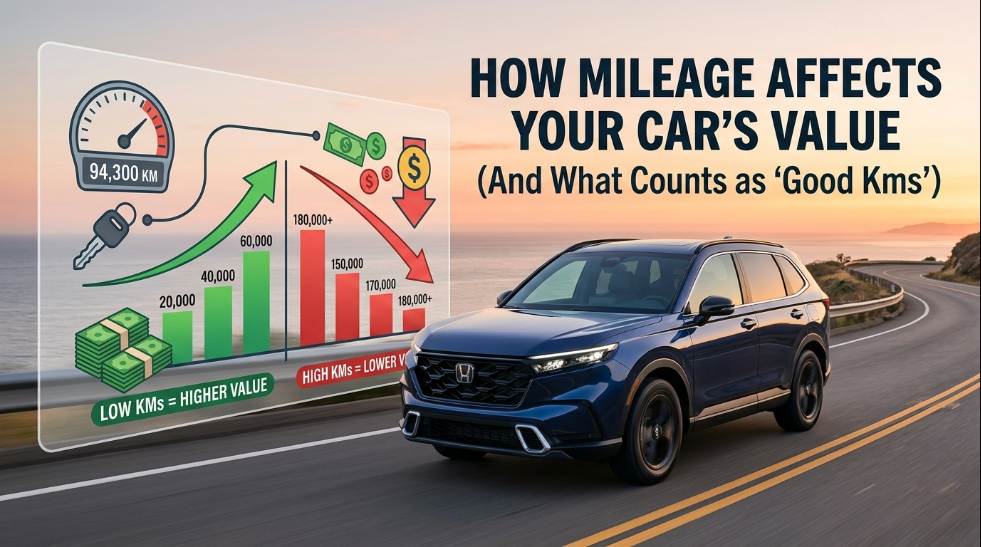
How Mileage Affects Your Car's Value (And What Counts as Good Kms)
Post by webuycars on 3 August 2026
Two identical cars, the same year and model, sitting side by side. One's done 60,000 km. The other's done 160,000 km. The mileage gap alone can be worth thousands of dollars, and it's usually the first number a buyer checks before they even look at the paint.
If you're trying to work out what is good mileage for a used car, or you're asking how does mileage affect car value in your specific situation, here's what moves the needle.
Quick Answer
Good mileage for a used car sits around 12,000 to 15,000 km per year of the car's age.
A 5-year-old car with 60,000–75,000 km is right in the middle of the average range. Go much higher or lower, and buyers start asking questions.
Multiply the car's age by 12,000–15,000 km, and you've got the average band. Here's how that breaks down:
Car Age
Low (Below Average)
Average
High (Above Average)
1 Year
Under 8,000 km
12,000–15,000 km
Over 20,000 km
2 Years
Under 16,000 km
24,000–30,000 km
Over 40,000 km
3 Years
Under 24,000 km
36,000–45,000 km
Over 60,000 km
5 Years
Under 40,000 km
60,000–75,000 km
Over 100,000 km
7 Years
Under 56,000 km
84,000–105,000 km
Over 140,000 km
10 Years
Under 80,000 km
120,000–150,000 km
Over 200,000 km
So what is good mileage for a used car in real terms? Anywhere in that middle column. It tells a buyer that the vehicle has been driven normally, not thrashed and not left to seize up in a driveway.
How Much Value Does Each Kilometre Cost?
How does mileage affect car value in dollar terms? There's no single figure that applies to every car, because it depends on the model, the market, and how far above or below average the odometer sits. But the pattern is consistent: every 10,000 km over the expected average chips away at resale value, and every 10,000 km under it can add a premium.
Say you've got a 4-year-old car that should sit around 50,000–60,000 km. If it's done 90,000 km instead, that's enough to push it into a different bracket when a buyer or valuer assesses it, often shifting the offer down more than a simple like-for-like comparison would suggest.
This is why we don't just plug your rego into a formula. Every used-car valuation we run weighs mileage against age, condition, and service history.
The 100,000 km Cliff
There's a psychological line in the sand at 100,000 km, and it matters more than the actual mechanical difference between 95,000 km and 105,000 km.
Many buyers filter used-car searches by odometer reading, and 100,000 km is a common cut-off. Cross that line, and your car drops out of a big chunk of searches automatically, before a single person even looks at the listing. It's also roughly where many manufacturer warranties expire, so buyers start factoring in larger service items that typically fall due around the 100,000–150,000 km mark.
Practically, this means a car at 96,000 km is often worth selling now rather than waiting another few months to reach 100,000 km. The value doesn't decline gradually; it steps down.
When High Kilometres Don't Matter Much
Not all kilometres are equal. A country car that's spent most of its life on the highway between Brisbane and Toowoomba tends to be in better mechanical shape than a city car with the same reading that's spent years in stop-start traffic, because highway driving is gentler on an engine.
A full, verifiable service history changes the equation, too. A 120,000 km car with every scheduled service logged is a safer bet than a 90,000 km car with gaps in the paperwork. Utes and diesels also tend to handle higher kilometres better than smaller petrol engines, since they're built for longer-distance work in the first place.
If your car falls into any of these categories, it's worth mentioning to whoever's assessing it. The number on the dash isn't the whole story.
The Low-Km Trap
Low kilometres aren't automatically a green flag. A car that's sat in a garage for years racks up its own problems: rubber seals and hoses perish from age rather than use, tyres develop flat spots from sitting in one position too long, and fluids degrade even if the engine's barely turned over.
This became a bigger issue after the COVID-19 lockdown years, when many cars did far fewer kilometres than usual and also missed scheduled services because workshops were shut or owners simply weren't driving enough to trigger a service reminder. So a low-km car from that era isn't necessarily in better shape than one with slightly higher, more consistent use. Check the service gaps, not just the odometer.
Mileage and EVs: A Different Rulebook
For electric vehicles, the odometer tells you a lot less than it does for a petrol or diesel car. What actually matters is the battery's State of Health (SoH). Essentially, how much of its original usable capacity remains.
Fleet data from Geotab, based on more than 22,000 electric vehicles, found average battery degradation of around 1.8–2.3% per year, with charging habits having a far bigger influence than distance travelled. Hotter climates added only around 0.4% extra degradation per year on top of that, a smaller effect than most people assume.
Two EVs with the same kilometres can have very different resale values, depending on how they were charged and whether the battery has been properly monitored. If you're weighing up an EV, it's worth reading up on the differences before assuming mileage rules apply the same way.
Selling a High-Km Car in Brisbane
If your car's mileage falls within the average range, the private market or a dealer trade-in will usually get you a fair price without much hassle. Once you're well past the average (especially over that 100,000 km mark), private buyers get pickier, finance approvals get harder, and dealers tend to lowball trade-ins to cover their own resale risk.
That's where our direct second-hand car sale process tends to work better. We assess the whole picture rather than filtering you out at a number.
Curious what your current kilometres actually mean for your car's value? Get an instant offer and see a fair price based on your specific car. If you're ready to move on, our top cash for cars Brisbane service can have an offer in your hands the same day.
Whatever the number on your dash, we buy cars across Brisbane in any condition, so it's worth getting a real assessment before you assume high kilometres mean a low offer.
FAQs
Around 12,000–15,000 km per year of the car's age. A 5-year-old car with 60,000–75,000 km sits right in the average range.
Usually not on its own. Buyers and valuers weigh both together, alongside service history and condition. A well-serviced high-km car often outperforms a neglected low-km one.
There's no fixed percentage, but crossing the 100,000 km mark tends to trigger a noticeable step down in value rather than a gradual decline, partly because it filters cars out of buyer searches and aligns with major service intervals.
Not necessarily. Diesels and well-maintained vehicles with full service records regularly exceed 200,000 km without major issues. Condition and history matter more than the number alone at this point.
Less than for petrol or diesel cars. Battery State of Health, driven mostly by charging habits, is a better indicator of an EV's remaining value than the odometer reading.
We Buy Cars is the easiest & most efficient way to sell your used car.
If you've been telling yourself "I need to sell my car", you're in the right place! Our team are waiting for your enquiry. Book today and get prompt and secure payment for your used vehicle.