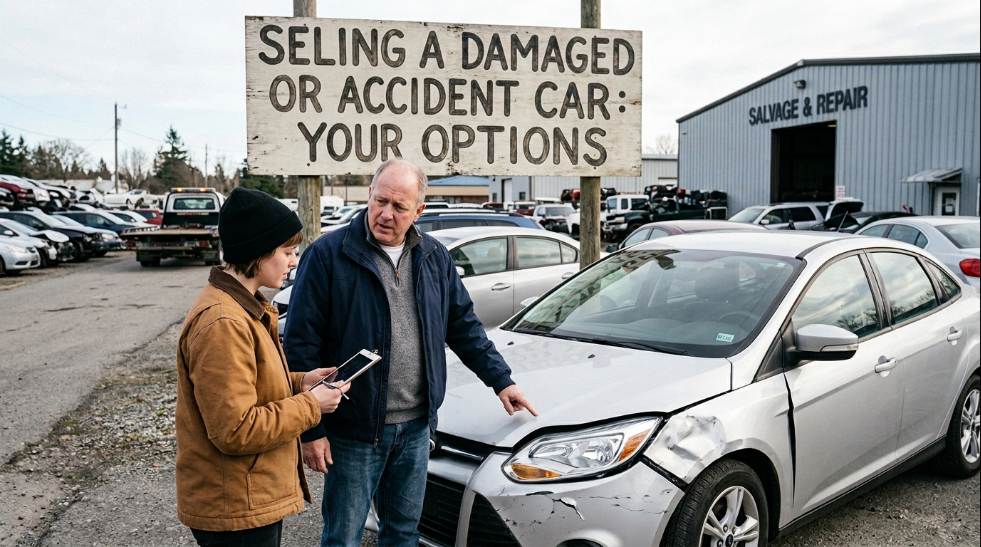
Got a dent, a write-off notice, or a bingle you're not sure how to explain to a buyer? You can still sell your damaged car, it's just a matter of knowing which category your vehicle falls into and which selling route pays off. Whether it's a cracked bumper or a full accident write-off, there's a legal, straightforward way to move it on.
Quick Tips
Minor damage (cosmetic dents, scratches, small mechanical faults) sells like any normal used car, just at a reduced price.
Repairable write-offs can be sold and, in most states, re-registered after passing an inspection.
Statutory write-offs can only be sold for parts or scrap. They can never go back on the road.
Selling a car with accident history is legal in every case, provided you disclose the damage and, where relevant, the write-off status. There's no scenario where an honest disclosure stops a sale.
A licensed cash for unwanted cars service will take any of the above off your hands without a roadworthy certificate or repair quotes.
First, Work Out What You're Dealing With
Before you decide how to sell your damaged car, it helps to know exactly what condition it's officially in. Damage falls into three broad categories.
1. Minor Cosmetic or Mechanical Damage
This includes hail dents, a cracked windscreen, a bung transmission, or panel damage from a low-speed prang. None of these triggers a formal write-off notification, so the car can be sold privately, through a dealer, or to a car-buying service exactly as it stands, with the damage disclosed upfront.
2. Repairable Write-Off (RWO)
An insurer decides that the repair cost plus salvage value exceed the car's market value, so they write it off, but the damage isn't severe enough to keep it off the road forever. The VIN is recorded as a repairable write-off in a written-off vehicle register, and it may be re-registered after passing the required inspection process. In Queensland, that means a Written-Off Vehicle Inspection (WOVI) checking the vehicle's identity and repair standard before Transport and Main Roads (TMR) allows it back on the road.
3. Statutory Write-Off (SWO)
This is the more serious classification. A statutory write-off is a vehicle assessed as a total loss with damage too severe to be repaired and returned to the road, and its VIN can't be re-registered in Queensland or any other Australian jurisdiction, even if repaired. These vehicles are only good for parts or scrap metal.
TMR determines the classification using a formula where total loss equals the cost of repair plus fair salvage value being greater than the car's fair market value, and the notifier (usually the insurer) decides which category applies.
Comparing Your Options
Option
Price
Speed
Effort
Best For
Private sale with disclosure
Highest potential
Slow (weeks)
High – ads, questions, negotiating
Minor damage only
Licensed car buyer
Fair, market-adjusted
Fast (same day)
Minimal – no roadworthy, no repairs
Any damage, including write-offs
Wrecker or salvage yard
Scrap/parts value
Fast
Low
Statutory write-offs
Repair then sell
Depends on the maths
Slowest
Highest – quotes, repairs, re-inspection
Repairable write-offs worth rebuilding
Insurance settlement, sell salvage
Payout plus salvage sale
Moderate
Moderate
Cars written off after an accident
Repair or Sell As-Is? The Break-Even Test
Before you spend a cent on panel beating, run the numbers. Get a firm repair quote, then compare it against what the repaired car would be worth back on the road (not what it was worth before the damage). If the repair bill eats most of the value uplift, selling as-is almost always wins.
The maths breaks down fastest with structural or frame damage. Chassis rails and suspension mounts are expensive to straighten correctly, and a poor repair can fail a WOVI inspection outright, leaving you with a car you've paid to fix and still can't register. If you're unsure where yours sits, get a proper read on what is the value of my car before committing to repairs either way.
Disclosure: What You Legally Must Tell Buyers
This is the part that trips up most sellers when selling a car with accident history. Any prior write-off status shows up the moment a buyer runs a PPSR check on your VIN, so trying to hide it isn't really an option.
Private sellers don't carry the same formal disclosure obligations as licensed dealers, but that's not a free pass. Knowingly misrepresenting a car's accident or write-off history to a buyer can still expose you to a claim for misrepresentation. Being upfront protects you either way, which is exactly why sellers who'd rather not manage that conversation themselves choose to sell their damaged car through a licensed buyer instead.
Selling a Damaged Car Without a Roadworthy in QLD
A common misconception is that every car needs a current roadworthy certificate before it can change hands. That's only true for private sales of registered vehicles.
If your car is unregistered or you're selling to a licensed motor dealer, no safety certificate is required. That makes it one of the simplest ways to sell a car without roadworthy hassles, particularly if the damage means the car would likely fail inspection anyway. A licensed buyer takes on that responsibility themselves.
What About Hail, Flood and Storm Damage?
Southeast Queensland's storm season creates a steady stream of hail-damaged cars every summer. Insurers regularly field thousands of motor claims from a single severe weather event – Suncorp alone received more than 3,700 motor claims across southeast Queensland and northern New South Wales from one late-2025 storm, and aseparate spring event generated more than 44,600 combined personal and commercial claims, with motor and home portfolios carrying the bulk of the losses.
Hail damage doesn't automatically mean write-off. Plenty of hail-dented cars are cosmetically rough but mechanically sound, and sell fine once disclosed. Flood-affected cars deserve more caution. Water ingress above the floor pan causes hidden electrical and corrosion problems for years, which is why flood history carries more resale stigma than hail dents do.
How to Sell Your Damaged Car With We Buy Cars
If you'd rather skip the disclosure conversation entirely, this is where a licensed buyer earns its keep. We Buy Cars is regularly asked to sell damaged cars by owners across Brisbane, the Gold Coast, Sunshine Coast, Ipswich, Caboolture, and Toowoomba, and the process barely changes whether the damage is a scraped bumper or a statutory write-off.
We provide an on-site assessment, settle any outstanding finance as part of the sale, and pay by EFT or Osko once you accept the price. No roadworthy, no repair quotes, no fielding a private buyer's questions about the accident. Request a quote on your car to get started, or read more on selling cars in Brisbane if you're still weighing up your options.
FAQs
Yes. Repairable write-offs can be sold and potentially re-registered after inspection. Statutory write-offs can be sold too, but only for parts or scrap.
Not if you're selling to a licensed dealer or the car is unregistered. A safety certificate is only mandatory for private sales of registered vehicles.
Any formal write-off notification does. A $2 PPSR search reveals whether a VIN is listed as a repairable or statutory write-off.
Often, yes. Many insurers allow you to retain the wreck at an adjusted settlement figure, which you can then sell to a wrecker or licensed buyer.
It varies by damage severity and repair quality, but a documented write-off history typically knocks a noticeable amount off resale value compared to an equivalent clean-history car, since buyers price in the uncertainty.
We Buy Cars is the easiest & most efficient way to sell your used car.
If you've been telling yourself "I need to sell my car", you're in the right place! Our team are waiting for your enquiry. Book today and get prompt and secure payment for your used vehicle.