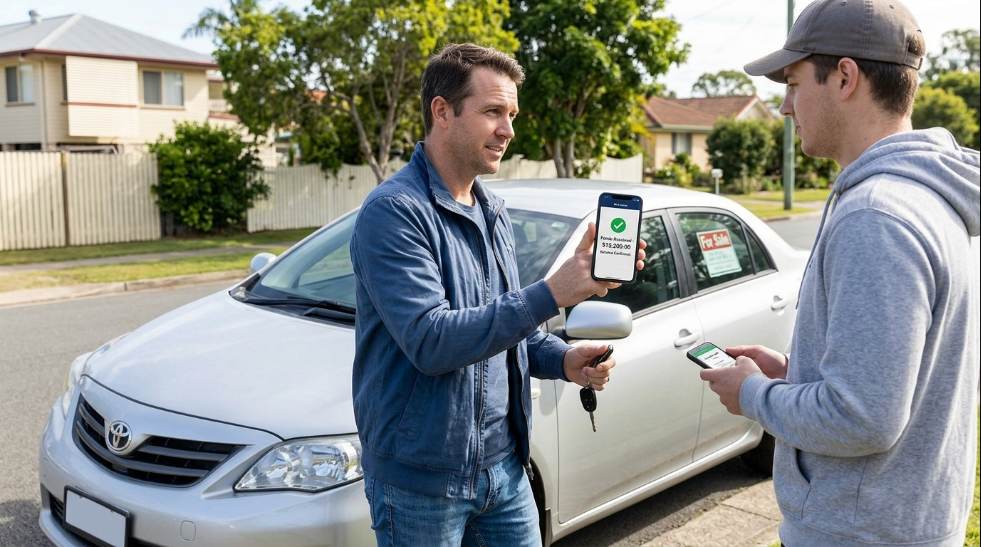
Avoiding scams when selling a car starts with one habit: never let the vehicle, the keys, or a refund leave your hands until the full sale amount is sitting in your bank account (or you’ve got the cash in your hands).
Vehicle sales are a favourite target for fraudsters because the dollar amounts are big enough to make a fake "overpayment" or a PayID upgrade email look worth the risk. Between January and March 2026 alone, Scamwatch received 45,816 scam reports, with more than 6,700 of those involving a financial loss. This guide covers the scams doing the rounds in Queensland right now, the red flags to watch for in that very first message, and the one selling method that removes almost all of the risk.
Anti-Scam Tips
Never hand over the keys, signed paperwork, or a "refund" until the full amount is confirmed in your own banking app.
Screenshots, email receipts, or a text saying "payment sent" shouldn’t be taken as proof of payment.
Osko and PayID both clear in minutes, so there's rarely a good reason to release the car before the money shows up in your account.
The 6 Most Common Car-Selling Scams in Australia Right Now
Fraudsters targeting private sellers tend to run the same handful of plays. Knowing how to avoid scams when selling a car usually comes down to recognising these patterns early.
1. The Fake PayID "Upgrade" Fee
A buyer insists on PayID, then sends a fake email claiming your account needs to be "upgrading" to a business account before funds can be released, and asks you to pay a small fee first. Scamwatch's own guidance is blunt on this: you should never need to pay money to receive money.
2. The Overpayment Refund Scam
The buyer "accidentally" sends more than the agreed price, then asks you to refund the difference. The original payment later bounces or reverses, leaving you out of pocket for the refund you sent.
3. The Fake Transfer Screenshot
Some scammers skip the bounced payment altogether and simply forward a screenshot of a "successful" transfer that never happened, pressuring the seller to hand over the car before checking their own balance.
4. The Sight-Unseen Courier Buyer
A "buyer" claims to be interstate or overseas (a defence deployment or FIFO posting are common excuses), offers full price without negotiating, and arranges a courier. You're then asked to cover shipping or customs costs upfront, which then disappear along with the buyer.
5. The Test-Drive Theft
A prospective buyer asks to take the car alone for a test drive, then simply doesn't come back (or swaps your keys for a duplicate set mid-drive).
6. The Dodgy Cash-for-Cars Price Drop on Arrival
An unlicensed "cash for cars" buyer agrees to a price by phone, then drops it sharply once your car is on their tow truck or in their yard, betting you won't want the hassle of getting it back.
Red Flags in the First Message
Scammers tend to give themselves away early. Watch for a buyer who:
Won't call or video chat, and only ever communicates by text
Agrees to your asking price immediately with zero negotiation
Dictates the payment method before they've even asked to view the car
Volunteers an unsolicited backstory about why they can't inspect it in person
Safe Payment Methods Ranked
Choosing the right payment method is one of the most practical steps to avoid scams when selling a car privately, since not all methods carry the same level of risk.
In-branch bank transfer: The safest option for higher-value cars, since a teller can confirm the funds have actually moved.
Osko or PayID, balance-checked yourself: Fast and generally safe, but only once you've confirmed the money in your own banking app, never from a screenshot the buyer sends you.
Cash, counted in a secure location: Fine for lower-value sales, though carrying large amounts of cash brings its own risks.
Refuse PayPal for goods, Western Union, wire transfers, cryptocurrency, or any "escrow" service the buyer suggests. These are consistently flagged in car-selling scams and are almost impossible to reverse once you've sent funds.
Test Drives Without the Risk
A test drive is where many car-selling scams turn physical, not just financial. A few habits reduce that risk substantially:
Sight and photograph the buyer's driver's licence before handing over the keys
Accompany every test drive. Never let a stranger take the car alone
Meet and test-drive in a public area with mobile reception, during daylight hours
Check with your insurer before the test drive; cover for an unlicensed or unfamiliar driver isn't guaranteed under every comprehensive or CTP policy
Protect Yourself After the Sale
The paperwork after the handshake is as important as the sale itself.
Get a signed receipt covering the buyer's name, licence number, sale date, price, VIN, and odometer reading.
Transfer your registration with Queensland's Transport and Main Roads (TMR). Qld.gov.au confirms you must transfer the registration within 14 days of the sale. It's free for the seller, and it's the step that disconnects you from any tolls, fines, or disputes tied to the vehicle after it's out of your hands. It's also the step scammed sellers most often forget in the stress of a bad sale.
Cancel or transfer your CTP and comprehensive insurance on the day of sale, and claim any refund for the unused portion.
The Zero-Scam Alternative: Selling to a Licensed Dealer
Every scam above relies on one thing: an anonymous buyer you can't verify. For most people, the simplest way to avoid scams when selling a car is to remove the anonymous buyer from the equation entirely and sell to a licensed dealer instead.
Before you commit, you can verify a car-buying business in about two minutes. Check their motor dealer licence number, look up their ABN on ABN Lookup, and confirm they operate from a real, physical premises you can visit.
If selling your car quickly in Brisbane sounds better than chasing an anonymous online buyer, We Buy Cars is a licensed car-buying service that inspects the vehicle in person, confirms your identity on the spot, and pays via Osko or EFT once a price is agreed. We also buy cars for cash in Brisbane and handle the paperwork and the payment in one visit.
If you want a sell car instant offer to compare against what you might get privately, it costs nothing to find out, and it removes every scam scenario covered above in one step. If you’re looking to sell your used car in Brisbane, get in touch with us to organise an inspection and offer.
FAQs
Yes, PayID itself is a legitimate, bank-backed payment method. The risk comes from fake "upgrade" or overpayment emails that ask you to pay money before you can receive it. A legitimate PayID payment never requires that.
Don't refund the difference. Contact your bank immediately and treat it as a likely scam. The original payment is very often fake or reversible, while any refund you send is not.
It's difficult. Osko and PayID transfers clear almost instantly, which makes them hard to reverse once sent. Contact your bank the moment you suspect a scam, and report it to Scamwatch.
No. Always accompany the test drive and sight the buyer's licence first, regardless of how genuine they seem.
Ask for their motor dealer licence number, check their ABN on ABN Lookup, and confirm they have a physical premises you can visit before you hand over your vehicle.
We Buy Cars is the easiest & most efficient way to sell your used car.
If you've been telling yourself "I need to sell my car", you're in the right place! Our team are waiting for your enquiry. Book today and get prompt and secure payment for your used vehicle.